

Published on 23 November 2026
Different perspectives, challenging questions and fresh ideas for the future of people and nature. RENEW’s final Biodiversity Parliament brought researchers and partners together to share what we’ve learned, explore what needs to change and look towards what comes next. We invited Devon poet Freya Gillard to our parliament to reflect on poetry, the Bog Talk project, and the question of biodiversity renewal.
What is the point of poetry when we talk about the renewal of biodiversity?
There is some presendence historically for poetry’s role in environmental justice, and the broader politics that overlap with it. John Ball, a prominent leader in the 1381 peasants’ revolt, preached the following couplet to the Kentish rebels that freed him from prison:
‘When Adam delved and Eve span / Who was then the gentleman?’
And poets have continued to engage with his sermon today. Later, Seamus Heaney would write through peatland and the bog bodies preserved within it, to reckon with the violence and upheaval of the Troubles.
The natural world serves poetry, yes, but how far can poetry serve it?
It’s a question poets can shy away from, and who can blame them – no one wants to be out of a job, and the benefits reaped by the RENEW project for its use of poetry to foster engagement with threatened landscapes may be evidence enough for its importance.
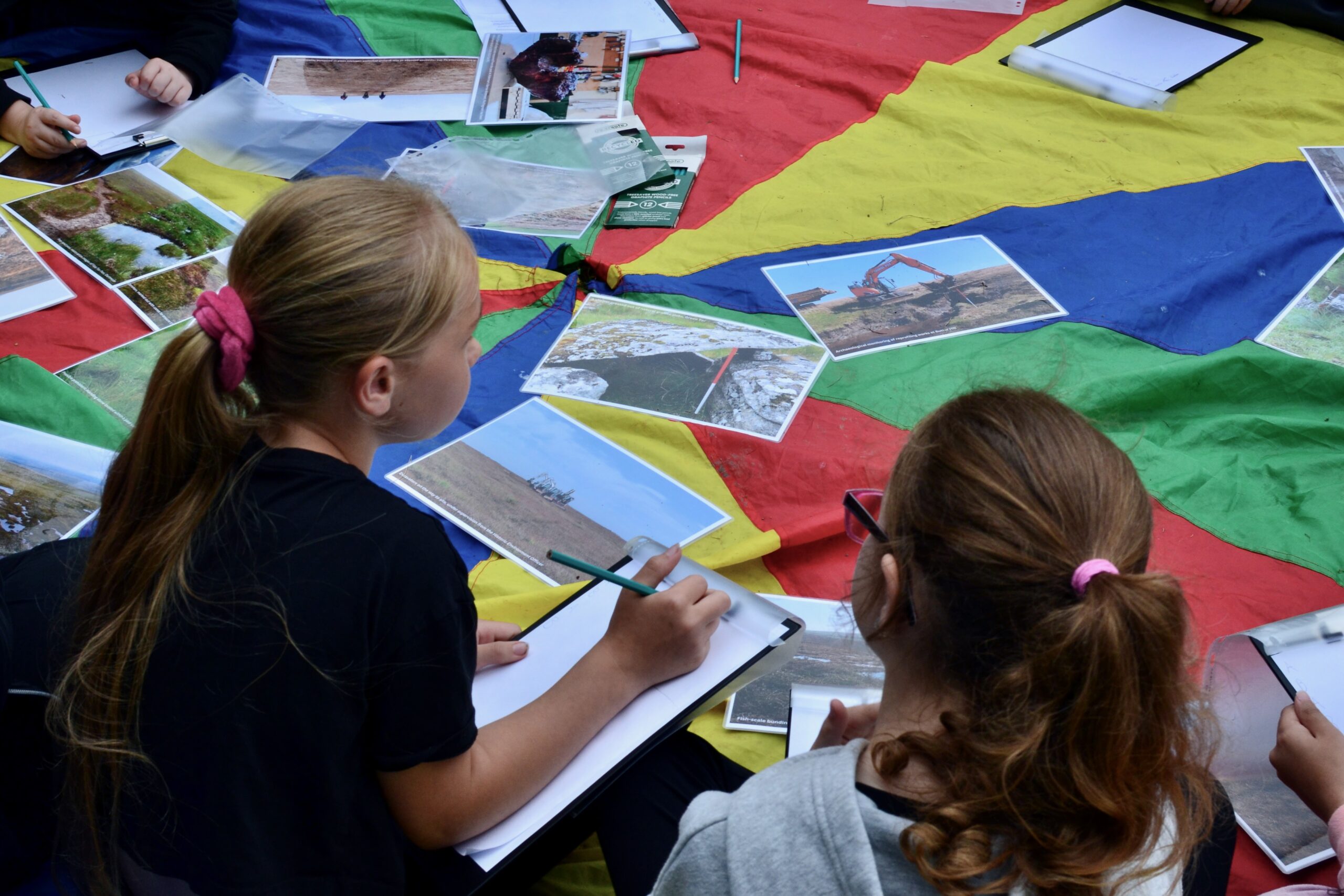
Through its partnership with The Poetry Society, the Bog Talk project sent poets into primary schools in the southwest to teach them about peatland. In collaboration with the South West Peatland Partnership, children were able to engage with bogs physically, handling sphagnum moss and peat, and creatively, learning about the value of peatland to prevent flooding, foster biodiversity and store carbon, which then prompted their own poems.

Photo: Bog Talk Workshop with ‘bog in a box’. Credit: Laura Ludtke for The Poetry Society
A vital aspect of poetry is ‘writing slant’, sneaking into your inspirations sideways to engage with them in novel ways. In that spirit, the learning resources developed during Bog Talk encourage young people to embody the bog, extend a radical empathy to landscape which will go on to fuel the work of environmental renewal.
Poetry can serve as an archive too, preserving a vivid impression of the natural world – not unlike a bog and its bodies. In his commissioned work for Bog Talk, Richard Scott examined this function of his creative practice, engaging with the literary heritage of peatland to render it in writing.
But here’s the ugly question: is it worth it? Would the time, money, and resources put into poetry be better spent somewhere else? Who are poets to write about nature, about land, about the people labouring on it – to be paid for it! – when there is other work that needs doing and more tangible change that could be made?
And yet they keep writing. Why?
Working as we do to protect and conserve the natural world, we accept a base duty of care for nature. Is poetry a kind of care? Maybe. Maybe not. Let me extend the question. Do we have a duty of respect for, exchange with, peership with nature? Then perhaps this is the point of poetry. As a species we have turned to poetry as long as we have been capable of making it. It is one of our oldest artforms and has long been used to tell histories, carry cultures, and cut to the core of human nature.
History. Culture. Nature.
The choice isn’t what we write our poetry about, but what we decide is no longer worth the effort. And if we ever do decide that the natural world – our world – is not worth the small effort of poetry, then that means it is not worth any other kinds of work either, conservation or research or restoration or respect.
We do not want to live in that kind of world. That is the point of poetry.
Photos: Laura Ludtke for The Poetry Society


