In June 2023, RENEW PhD students visited Tuckingmill, near Camborne, Cornwall, for a walk with poet and professor John Wedgewood Clarke, one of the leads on Theme 2, Community Action. John previously ran a research project investigating the history, ecologies and stories of the Red River, which runs from the heart of Cornwall’s historical mining landscape into St Ives Bay. Joining them was Steve Jones, the joint coordinator for the Red River Rescuers, a lifelong advocate for wildlife in the area and an expert in Cornish insects.
Despite the historically polluted water and unnatural flow of the straightened river, the old mining works at Tuckingmill have become important habitats for flora and fauna and one of the few sites where the Scarce Blue-tailed Damselfly thrives in the UK.
As well as damselflies, the tanks were home to a diverse mix of insects, birds and wildflowers and for this reason, the Red River raises questions about how and what we value as ‘nature’. The Red River is a very human landscape, shaped by the working hands of the generations who came before us.

Above: Red River inhabitant the Common Blue Damselfly, Enallagma cyathigerum. (Photo: Kelly Stevens)
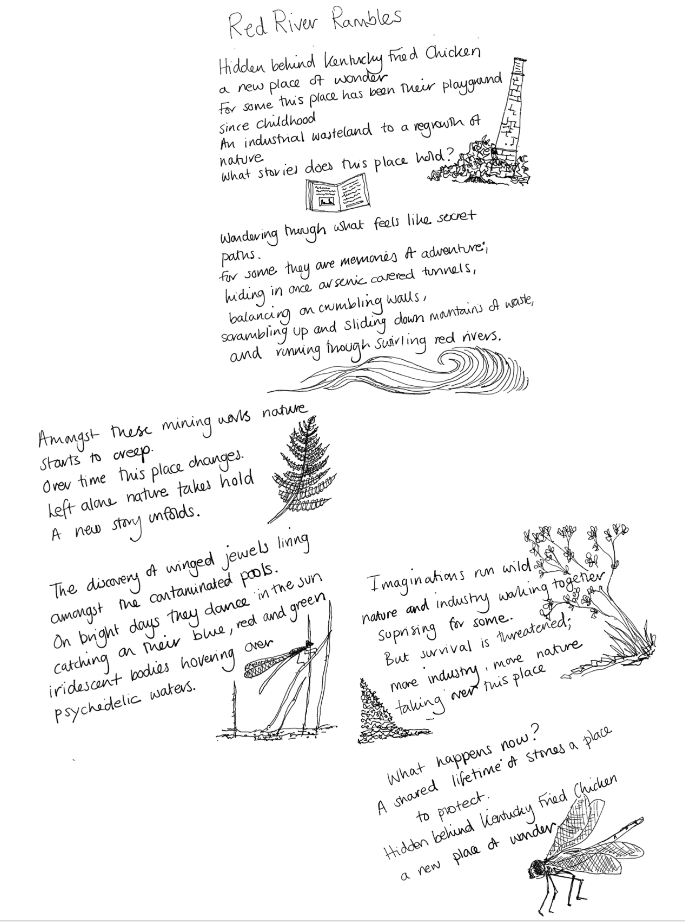
Humans relate to landscapes in complex ways. What one person sees as spoiled, another may view as beautiful or meaningful in ways that may not be easy to understand or be obvious to the outside observer. We were guided through our responses by John who shared a poem by Juliana Spahr (Gentle Now, Don’t Add to Heartache). A padlet was created in which the group could share their perspectives and poetry, which led to rich and thoughtful discussions.
Tuckingmill Valley Park, Tolgarrick Road, Tuckingmill, Camborne | Kelly Stevens
After Juliana Spahr (Gentle Now, Don’t Add to Heartache)
Dreaming of tin streams, arsenic stacks, stamp engines,
The past imprinted in the landscape.
Flurries of poisonous soot made themselves at home.
They stayed long after everything else had left.
Clambering over the mining detritus, boys played on industrial waste.
Gradually the green returned, silent, insistent, unstoppable
Soaking up the arsenic, water in slow motion
Pooled in white water spittle, pink algae, red sludge.
The trout learnt to flourish,
The scarce blue-tailed damselflies settled in
Welcoming the bare, barren space gifted by toxins.
We stand at the edge of the polluted water entranced by the colours
Looking at ghostly bodies, long gone creatures
The willows surround the pond, the reeds and yellow flags wave,
Tuckingmill Valley Park, Tolgarrick Road, Camborne | Sketchbook extract by Em Squire

Above: RENEW’s Early Career Researchers join Steve Jones, joint coordinator for the Red River Rescuers. (Photo: Kelly Stevens)
Understanding the complex relationships between people, identity, landscapes and biodiversity is a core focus of the research of the RENEW programme, and this visit provided an excellent chance for us to explore this in a thoughtful and tangible way.