Published on 12 May 2026
We are delighted to share this blog, written by Jo Smith (Chief Executive, Derbyshire Wildlife Trust) and Flavia Ojok (Deputy Director of Equity and Green Skills, Derbyshire Wildlife Trusts). They took part in a panel of three practitioner case studies and presented ‘In the Age of Polarisation, How Can We Remain Firm in Delivering Anti-Racist Environmental Action?’ at the Environmental Justice parliament hosted by RENEW in November 2025.
In a world grappling with environmental and social degradation and deepening divides, what does it look like for an organisation to respond with fairness, care, and a commitment to community, believing that these values can shape a more just and wilder future?
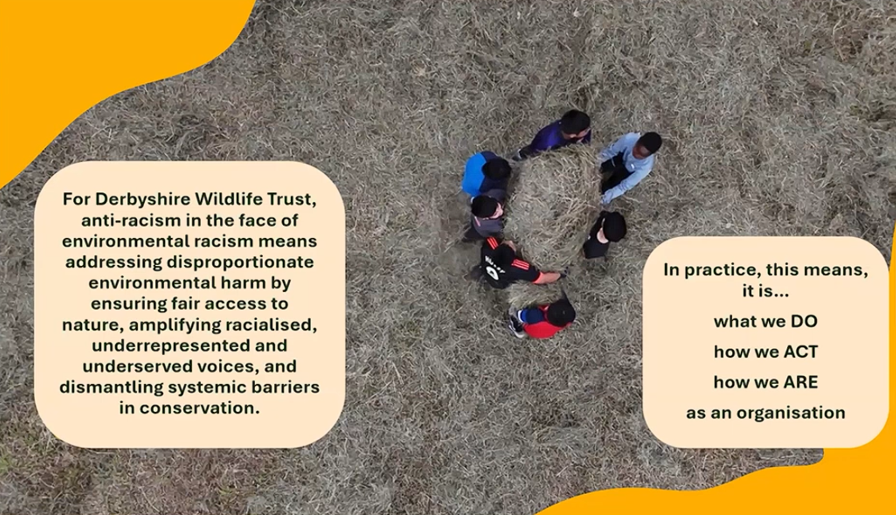
At Derbyshire Wildlife Trust, we believe that restoring the natural world requires unparalleled systems thinking. It requires us to strive for multi-species justice, intrinsically recognising and leaning into the interconnectedness of natural our world. That means, alongside reintroductions, rewilded landscapes, we also focus on rewilded people. In this frame, equity, justice and nature recovery aren’t separate goals, they’re inseparable. Therefore, embedded in our work is tackling and dismantling barriers, exploring ways to share power and building an anti-racist organisation. To us, this is how we create a future where every species can thrive in a flourishing natural world.
Embedding this work for us has been a journey, and will continue to be one. We started with the obvious steps: paid training placements for non-graduates and those excluded from environment roles, becoming a Real Living Wage employer, and introducing flexible working like a nine-day fortnight. These changes mattered; they were pivotal in platforming our organisation as one that does not simply believe in fairness, care, and a commitment to community, but one that acts on this believe. This enabled us to start our journey from a place of real authenticity. Which to us is a key principle, made even more apparent as divides deepen.
From staying principled, we’re now tackling the deeper work: shifting power, unlocking leadership pathways, and embedding anti-racism into our culture and decisions. Our learnings so far have shown us that this isn’t quick work; it takes trust, time, and courage in a world where conversations about equity can feel divisive, and inclusion work is often framed as ‘political’ or ‘ideological.’ What we’ve learned is that in the face of this, how we move matters as much as how far we go. For us, that means staying true to the principle of authenticity we built from the start, listening deeply, and valuing lived experience over performative action. To us, this is how fairness, care, and a commitment to community shows up. Recognising and acting on the fact that fairness and the belonging it can invoke aren’t partisan positions, they are humane, multi-species values.
This commitment has led us towards being more courageous when it comes to challenging ourselves. We are aiming to create spaces for honest dialogue, we want to be actively using tools like equality impact assessments throughout our work, and we want to actively model transparency, fairness and power sharing throughout our projects. We have seen that this can and does work, from projects like Allestree Park Community Rewilding and Nextdoor Nature where communities help shape decisions, not just receive them.
We want to do more of this, we know we can do more and if anything, the rise of deepening divides requires us to do more. It requires us to go deeper. From leadership diversity to platforming the ever-silenced voices of those society actively marginalise; there is ample work to do to drive change. This requires us to be bold, to tread with ample respect and importantly to tackle the challenge of decentring our organisation and sharing power. To us this is not only how we achieve the much-needed change for people and wildlife, but it is also how we show up as polarisation grows. This is how we stay principled and proactive, showing that fairness, inclusion, and equity are at the heart of credible environmental action, not an optional add-on.
This work and all that comes with it, from anti-racist actions to deliberate internal and external proactive challenges, isn’t about guilt or blame; it’s about pride, belonging, and hope. It’s about embedding co-design, community steering, and diverse governance into everything we do. Through this work, we will listen, reflect and channel even more agency towards communities. Our approach is simple but powerful: fairness, care, and shared action is the bedrock towards a Wilder Derbyshire.
Listen to this recording of the case study on delivering inclusive and anti-racist environmental action: Practitioner Case Studies: Panel 2.
See the work of Derbyshire Wildlife Trust in action: Derbyshire Wildlife Trust recognised for fairness, inclusion and empowering communities
For other recordings from the Environmental Justice event, see: RENEW > Biodiversity Parliament 2025: Is Nature for All? Exploring Environmental Justice