Published on 24 June 2026
RENEW colleague Siddharth Unnithan Kumar gives an account of the MOTH Festival of Ideas, an interdisciplinary event exploring more-than-human rights and the ethical, legal, and social responsibilities toward the living world.
One of my naughty secrets is that I have never been to an academic conference before – at least, not until a few weeks ago. Sitting indoors for long periods, talking and cogitating without moving my body much, is not something I had felt interested in. But the More-Than-Human Life (MOTH) collective, whose annual Festival of Ideas combines conference-style presentations with festival-style talks and performances – intertwining storytelling, law, science, arts, and political action, with non-Western peoples taking centre stage – seemed to be doing something different. So I attended their Festival in May this year, held in central London.
The mornings were organised around a uniquely participatory conference style. In preparation for the Festival, each attendee was requested to submit a paper they’d like to discuss and have feedback on; we were then clustered into four groups, and invited to read the papers sent in by other people in our group. Over the three mornings of the Festival, we took turns to present our work and engage in group discussion.
The stunning range of topics and speakers in my group, and the depth and wholeheartedness with which people presented, made an impression on all present. The room filled with tales of climate litigation being written into opera and performed in concert halls in Australia; the importance of cultivating somatic empathy for attuning to the lifeworlds of other-than-human beings; the cosmic Law of Origin practised at the heart of the world (the Sierra Nevada de Santa Marta); centering consent in how we approach and relate with other beings; and developing our lateral lines (subtle organs of perception inherited from our fish ancestors) for practising slow science, a science that eschews the fast-paced publishing-addicted narratives of capitalist scientific agendas in favour of more deliberate, relation-building, thoughtful approaches to research that work with the ‘thickness of the present moment’.

MOTH director César Rodríguez-Garavito introducing David Abram / Photo Credit: Siddharth Unnithan Kumar
On the morning of my presentation, I walked the banks of the Thames, whose waters I drink and swim in sixty miles upstream, in a region where she is called Tamesis. I looked around me at the built environment of central London, the still-beating heart of British imperialism, militarism, and supremacy, and thought of something Audre Lorde had famously said: the master’s tools will never dismantle the master’s house. Whatever I had prepared for the conference, I spoke it to the winds and waters, and to the gently swaying planes and scavenging corvids, whose relaxed and playful temporalities obliquely intersected the hectic tempo of the human hubbub. Because, inspired by geophilosopher David Abram, I wished to see whether my words felt true when speaking to the more-than-human world, when offered in conversation with the animate presences and powers with whom we share this shatteringly precious earthly cosmos, rather than just speaking about other beings from within the walls of human institutions.
An hour later, when my turn came to present, I outlined a vision (developed collaboratively with many friends and teachers) for an ‘ecological mathematics’. Namely, a mathematics that honours the unfathomable intelligence of the body and its relation with the breathing earth; that can draw on and be reworked through critical insights from the social sciences and humanities; that becomes cognisant of and seeks to heal the colonial and patriarchal narratives which continue to guide Euro-American academic mathematical practice; and that foregrounds the land-based mathematical practices of Indigenous peoples that have historically been denigrated and exiled from mainstream mathematical discourse. I was surprised by the response – there were no mathematicians in my group, yet the message seemed to resonate with other attendees, who offered beautiful ideas ranging from psychogeography counter-mapping to crafting mathematical structures with stingless bees, from changing the modernist metaphors of linearity and individualism that underpin many familiar Western mathematical ideas (in economics especially) to the seminal work of African scholars on embodied forms of mathematics.
Over the three days of gathering together, a feeling of friendship, collective inquiry, and finding allies suffused the conference sessions, and was present in the festival sessions too. The power of collective grieving, dreaming, and loving can’t be overstated!
The amazing Patricia Gualinga, International Relations Director for the Kichwa First People of Sarayaku, spoke of protecting her territory and working with other Amazonian peoples (women especially) to refuse the illegal mining practices that destroy – and destory – their ancestral lands. She spoke of the invisible beings that guard their forests in the heart of the Amazon region, and how the human body is a precise instrument for feeling and communicating with these beings. Later in the Festival, Patricia’s words were complemented by the screening of a beautiful documentary – Allpa Ukundi, Ñukanchi Pura: Underground, Around, & Among Us – in which Sarayaku leader José María Gualinga Montalvo spoke of their primary means of ecological knowledge production as telepathy, thought, heart, and wisdom, rather than the digital devices used by scientists.
World-renowned plant scientists Monica Gagliano and Suzanne Simard spoke of their ongoing journeys in the academic research community. In particular, having to refuse the patriarchal assumptions still held my many Western scientists – that living beings are objects rather than subjects, that humans have the right to possess and kill in the name of science – and withstand the often-violent reactions they received from male scientists for using the term ‘Mother Tree’, or speaking of plants as intelligent and having memory and feeling. Nonetheless, Monica and Suzanne decided to stay with the difficulties of Western science and introduce change from within, letting plants be their teachers directly and honouring that we humans are not disembodied observers but are thoroughly part of this world that we study – as Suzanne said, we are the forest. This was echoed by the respected and beloved Maori leader Aperahama Edwards, Chairman of the Ngatiwai Trust Board, who explained the importance of understanding and listening to whales, not to somehow ‘prove’ they are intelligent (indeed, why not just assume this in the first place?), but rather to enter into deeper relationships with them – because the creatures whom we study are also those very same creatures that we, as citizens of this breathing biosphere, live alongside.
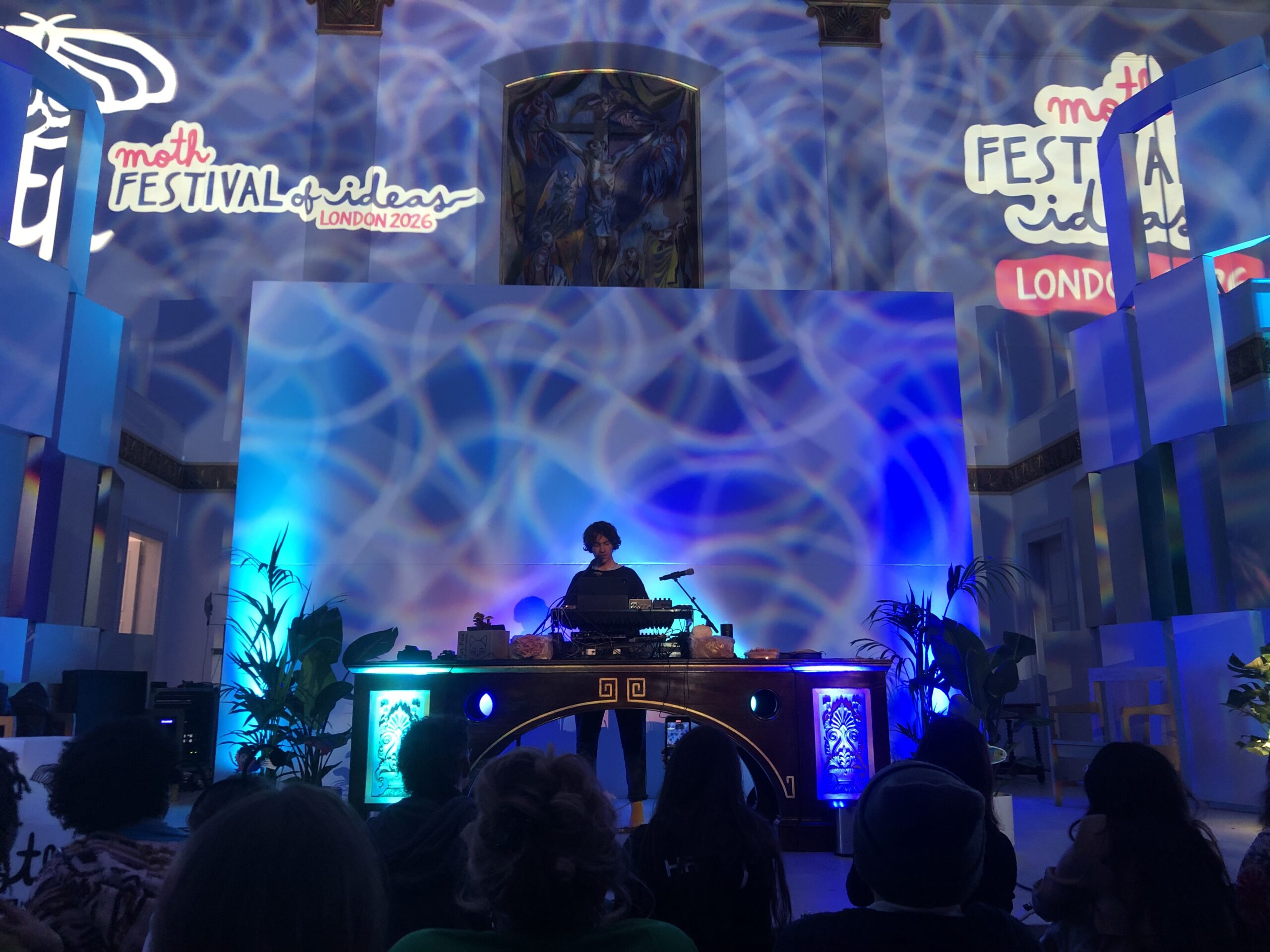
Many other deeply inspiring two-leggeds contributed with the magic and mystery of the Festival’s three expansive days. To name a handful: Kate Raworth did a doughnut economics circus; Alex Lucitante discussed ancestral science and plant medicine, and played two beautiful guitar songs; Rob Macfarlane spoke of co-creating music with the Los Cedros cloud forest; and David Abram performed the story of an encounter with Humpback Whale and Sea Lion that had the entire audience spellbound. In the darkening dusk of the Festival’s middle day, musicians Modern Biology and Cosmo Sheldrake made music with fungi. And on the final day, when the surrounding streets were charged with tension and protests, master of ceremonies Vanessa Richards reminded us of what Malcolm X had said: that light leads to understanding, understanding leads to love, love leads to unity, and that when ‘I’ becomes ‘we’, illness becomes wellness.

Cosmo Sheldrake in concert / Photo Credit: Siddharth Unnithan Kumar
Acknowledgement: this memorable and cherished experience of the More-Than-Human Life program’s Festival of Ideas was made possible by my beloved friend and mentor, David Abram; by my dearest ally and partner-in-mischief, Elvina (Elvy) Magdalena Moonbeam Crowe; and by the wonderful MOTH collective themselves. A bow of gratitude also to the RENEW programme, for kindly supporting my travel and attendance at the Festival.